
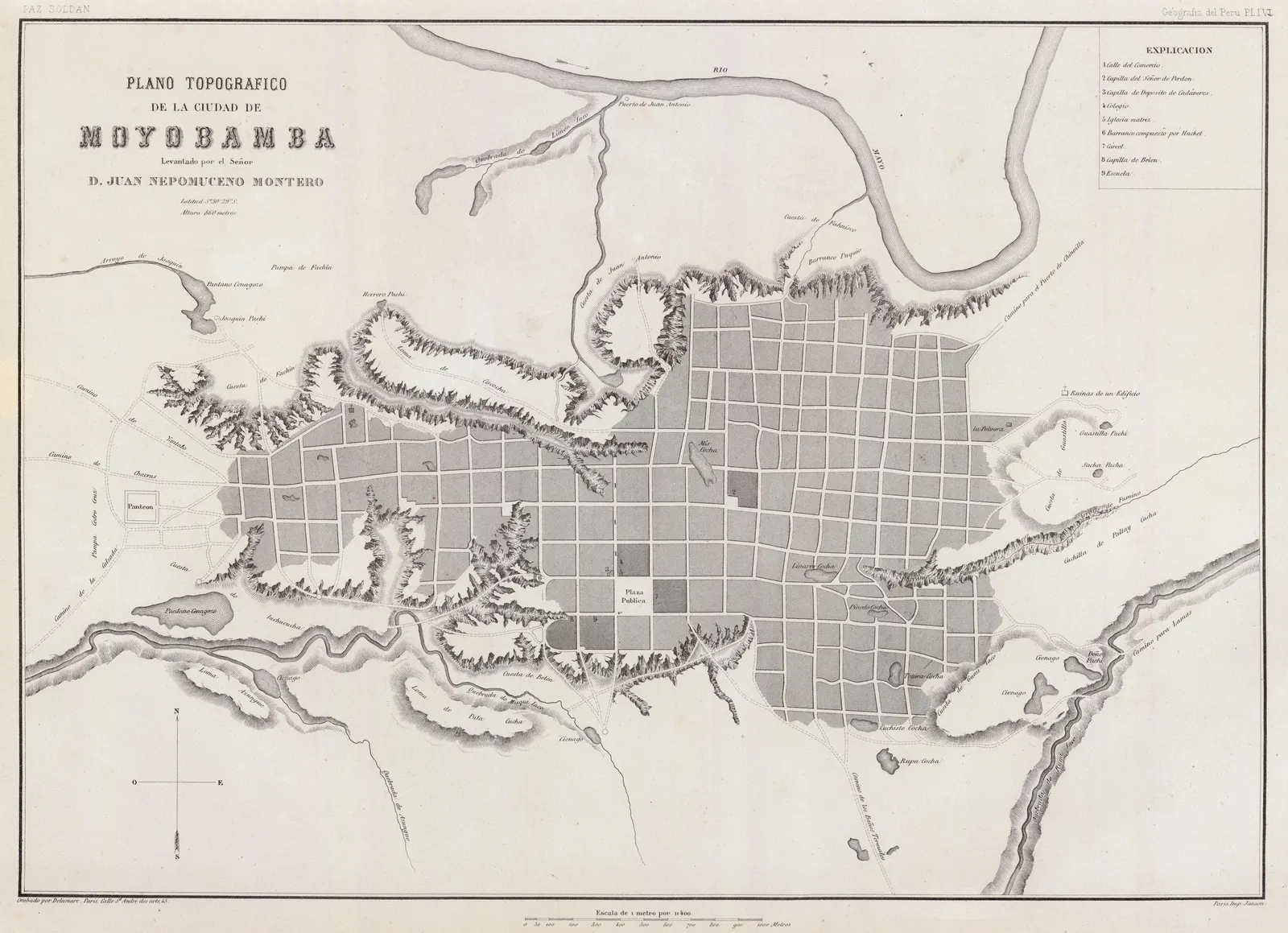
Moyobamba is not only old. Over the last two centuries it has been a capital, a seat of government and, more than once, a city that had to rebuild itself. This overview covers the best-documented moments.
1821: Moyobamba joins independence
In northern Peru, independence spread in 1821 from Trujillo, where the Marquis of Torre Tagle had declared for the patriot cause. According to a study published in the Revista del Archivo General de la Nación (journal of Peru's national archive), Moyobamba's act of independence is dated 14 August 1821.
The act mentions a letter sent by Torre Tagle from Trujillo, reporting that José de San Martín had entered Lima.
The declaration did not end the matter. The royalists prepared a counter-offensive in the region. Trujillo organised a division for Maynas, with reinforcements under Lieutenant Colonel José Nicolás Arriola. After several clashes, that force entered Moyobamba and secured independence.
A capital of the Amazon in the 19th century
In the 19th century, Moyobamba was the administrative centre for much of the Peruvian Amazon. Laws held by the Library of Congress show it step by step:
- 1857: a law names it capital of the Provincia Litoral de Loreto.
- 1866: a decree creates the province of Cercado de Moyobamba, with the districts of Moyobamba, Calzada, Habana, Soritor and Rioja.
- 1868: a law makes Loreto a department and raises Moyobamba, until then a villa (town), to the rank of city.
On 4 September 1906 the law creating the department of San Martín was enacted. It was formed from the provinces of Moyobamba, Huallaga and San Martín, separated from Loreto, with Moyobamba as its capital. It still is, as capital of the San Martín region.
The 1990 and 1991 earthquakes
On the night of 29 May 1990, a strong earthquake shook the Alto Mayo. Less than a year later, on the night of 4 April 1991, another one struck. There had been a foreshock that morning, and many families chose to sleep outdoors.
Researchers Eduardo Franco and Andrew Maskrey studied both disasters. According to their work, in 1990 about one in five homes in Moyobamba was damaged, out of some 6,000 in the city. The Prefecture and the municipal building were badly hit. In 1991, 3,080 homes were reported destroyed, half the city, along with 11 deaths and 137 injured in Moyobamba.
Most of the houses that fell were built of tapial, rammed-earth walls. Some buildings poorly repaired after 1990 collapsed in 1991.
Rebuilding with what was at hand
Reconstruction was slow. Franco and Maskrey report that the Banco de Materiales (a state building-materials lender) only made loans in Rioja, despite requests to open an office in Moyobamba. Many families could not qualify because they had no property title. In the Lluyllucucha neighbourhood, residents organised themselves to apply for self-build loans from ENACE, a state housing agency.
The best-known experience was quincha mejorada (improved quincha): a reinforced version of traditional cane-and-mud building, developed by the NGO ITDG with local cane and timber. The improved-quincha houses built in Soritor after 1990 withstood the 1991 earthquake. With support from Caritas, the programme spread across the Alto Mayo, and many residents built on their own using the same technique.
The authors' lesson was clear: reconstruction worked best where there were strong local organisations and techniques suited to local materials and budgets.
If you are looking for a house in Moyobamba today, this history is useful. Ask what the house is built of and when, and consider asking an engineer for an opinion before you buy.