
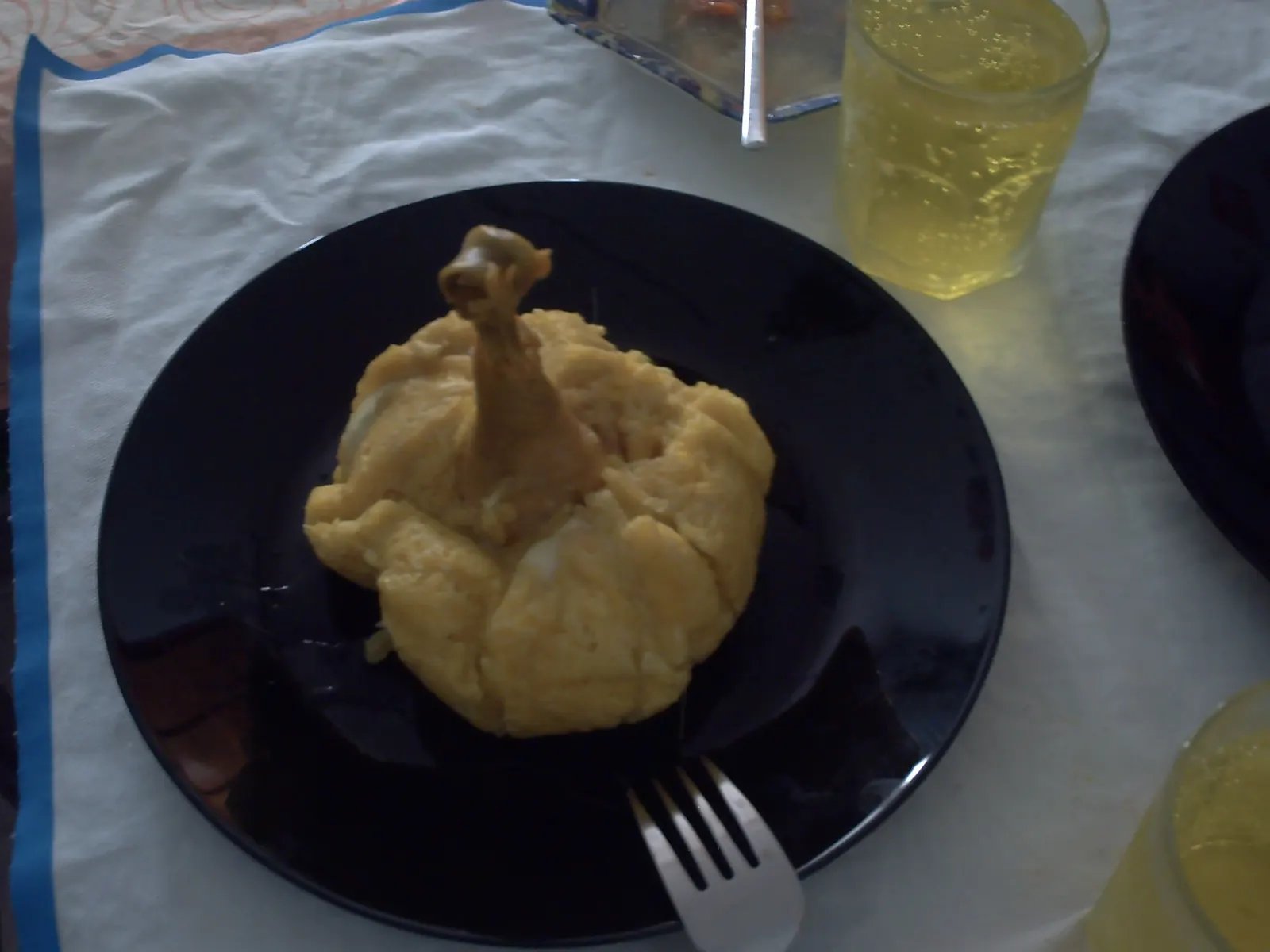
PromPerú presents it as one of the most representative dishes of the Peruvian Amazon, and Andina calls it the emblematic dish of the jungle. Its big moment is June, for the feast of San Juan. This is its story, told with what is known and what is still oral tradition.
What a juane is
A juane is a seasoned rice dough wrapped around a piece of hen or chicken, a hard-boiled egg and an olive. It is flavoured with onion and spices such as sachaculantro (a broad-leaf coriander) and achiote (annatto). Everything is wrapped in bijao leaves and cooked until it forms a compact, round bundle.
It is usually served with fried plantain slices and a sauce of ají charapita (a small Amazonian chilli), cocona juice and chopped onion. To drink, a fruit juice of aguaje, camu camu or cocona.
San Juan and the juane
The feast of San Juan (Saint John), every 24 June, is the great celebration of the Peruvian Amazon. Saint John the Baptist is regarded as the patron saint of the jungle, and the juane is the feast's main dish. How the city celebrates it is in San Juan in Moyobamba.
There are two explanations for the name, reported by the state news agency Andina and by PromPerú:
- One comes from language. Amazonian communities knew the dish as huanar, which would have become huane, with the idea of something slow-cooked, and later juane.
- The other comes from the feast. Missionaries brought the celebration of San Juan to the Amazon, and the dish's name would recall the saint. According to popular tradition, its round shape evokes the head of John the Baptist.
The feast begins with the baño bendito (blessed bath): people bathe in rivers, lakes and waterfalls to purify themselves and ask for the saint's blessing.
PromPerú adds a detail of interest to people in Moyobamba: according to its website, the juane was born in Moyobamba. That is PromPerú's version; Andina does not name a place of origin. Either way, it shows how closely the dish is tied to this city.
A dish that changed with history, and its variants
The first juanes had no rice. According to Andina and PromPerú, they were made with cassava, fish, callampas (a wild mushroom) and the eggs of forest birds. With the arrival of the Spanish came hen, olives and other seasonings.
According to Andina, rice arrived in the 19th century with Asian immigration. Its cultivation spread from the coast to the ceja de selva (the high jungle), above all in San Martín, and it ended up replacing cassava as the main ingredient.
Today some versions have their own names, according to Andina:
- Juane de yuca: the dough is ground cassava instead of rice, filled with fish, often paiche.
- Juane de chonta: chopped chonta, the palm heart of certain palms, is added to the rice dough.
- Avispa juane: the rice dough includes ground pork, and it is filled with a piece of fried hen.
- Nina juane: instead of rice, it has pieces of hen with beaten egg.
- Sara juane: instead of rice, it has ground raw peanuts, ground maize and chicken broth.
There are also juanes with minced beef, offal or fish, according to PromPerú.
Where to eat it in Moyobamba
We don't recommend specific places, because they change over time. Ask at the market or at regional restaurants where it is being made that day. Its big moment is June: for San Juan, many families buy the ingredients at the market ahead of time and cook it at home.
If it is your first time, order a classic hen juane with its plantain and chilli sauce. If you like it, ask about the variants: trying them is a good excuse to chat with whoever is cooking.